
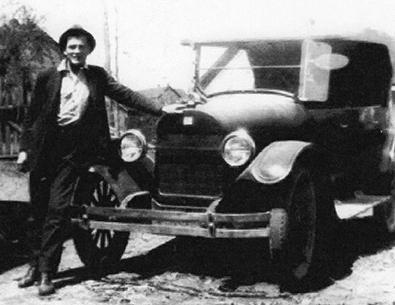
Prior to 1838, there is no record of any roads in Graham County: only old Cherokee Indian trading paths that were only narrow trails at best.
The first wagon road was the road built from Andrews to Robbinsville around 1838 for the removal of the Cherokees. It was built by the U.S. Army and is not the present Tatham Gap gravel road of today. This road was built by the CCC, for access to the fire tower on Joanna Bald.
It is uncertain as to just when what is now U.S. 129 was built. It was first a Cherokee Indian trading route and then improved to a wagon road constructed by General Winfield Scott, the same general that was over the building of the road from Andrews to Robbinsville, probably sometime after 1838.
The Barker wagon road ran from Andrews to West Buffalo for the purpose of hauling lumber from West Buffalo, Little Snowbird and Birch Springs to Andrews.
It was probably built shortly after 1897.
In 1902, a wagon road was built by Kanawha Lumber Company from Andrews and going by Webb Mill Creek, Walker Fields, down to Atoah Gap, on to Little Snowbird, Big Snowbird and through Hardslate Gap to West Buffalo. It too was called the Barker Road. Shortly after 1902, a road was built through Eller Cove near Atoah and Lige Branch.
It wasn’t until 1931 that Tapoco could be reached by automobile from Tennessee. In 1931, an all-weather road (U.S. 129) – connecting Graham County and Tennessee – was completed.
In 1929-1930, a road, (now N.C. 143 Sweetwater Road) was constructed from Robbinsville to Johnson Gap on N.C. 28. In 1934, U.S. 129 was constructed from Topton to Robbinsville, replacing N.C. 108.
In 1955, N.C. 28 was built from Stecoah to Fontana Dam. And finally, in the late 1960’s, U.S. 129 North was reconstructed from Robbinsville to Tapoco.
Marshall McClung is the historical columnist for The Graham Star. He is retired from the Graham County Rescue Squad. Email him at mcclungs@email.com.