

Marshall McClung
Senior citizens say that you have to be tough to handle old age.
Joyce Kilmer Forest would certainly qualify as an “old timer “and has withstood several tests of nature and man.
Most notable was the arrival of the chestnut blight that virtually wiped out the American Chestnut tree.
The blight was first discovered in 1904 in New York. It is estimated that the American Chestnut made up 25 percent of the trees found in our local mountains.
The southern pine beetle – whose scientific name means “tree killer” – is considered to be the most destructive insect pest in the United States. The pine beetle makes periodic passes through our area from time to time.
In the 1960s, the elm spanworm arrived in our area. It didn’t just attack elms, but also hickory, oaks, maple, beech and other hardwoods.
The only positive thing about the elm spanworm was that it was good fish bait.
In the summer of 1962, the U.S. Forest Service had contracted a private company to spray Joyce Kilmer Forest by using a helicopter to help control the spanworm.
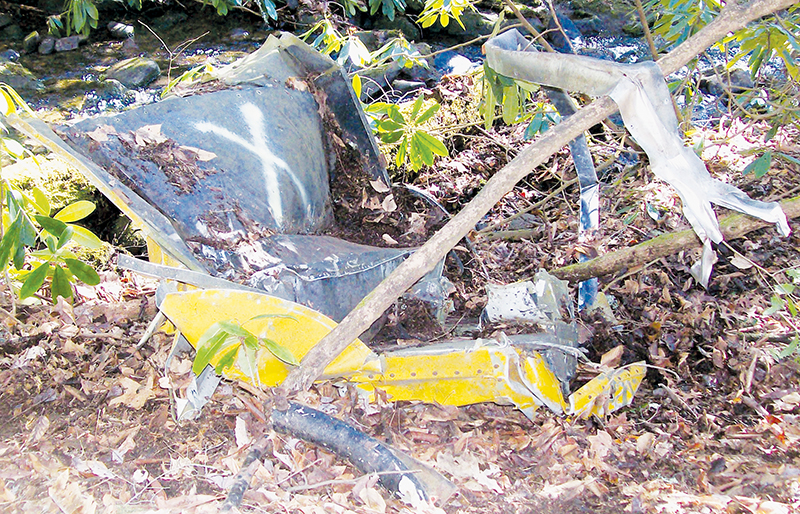
The helicopter crashed during the spraying operation. The pilot survived, but was injured and – in a dazed condition – began walking up the hill on the Naked Ground Trail, instead of going downhill to the parking lot. He was found by U.S. Forest Service employee Gudger Buchanan. Word was later received that this pilot crashed again on the next operation elsewhere – and this time, did not survive.
In February 2009, Mitch Hyde was searching for his hunting dog in Joyce Kilmer Forest when he came across some aircraft wreckage. Hoot Gibbs, myself and Civil Air Patrol member Jeff Wadley accompanied Hyde to the wreckage on what is known by locals as “Fire Camp Branch;” but on the map is listed as “Adam Camp Branch.” The wreckage was that of the helicopter that went down during the elm-spanworm spraying operation.
One strange item turned up, in that neither the National Transportation Safety Board nor Federal Aviation Administration has any record of the crash.
Years later, the hemlock wooly adelgid arrived.
It is estimated that the hemlock wooly adelgid has killed around 95 percent of the eastern hemlocks.
The next attack came from man – not nature.
In 2016, there were several large forest fires that appeared to have been deliberately started by woods arsonists.
One of these large fires burned part of the Joyce Kilmer Forest – but thankfully, not the area where the largest trees are located.
Marshall McClung is the historical columnist for The Graham Star. He can be reached via email, mcclungs@email.com.