
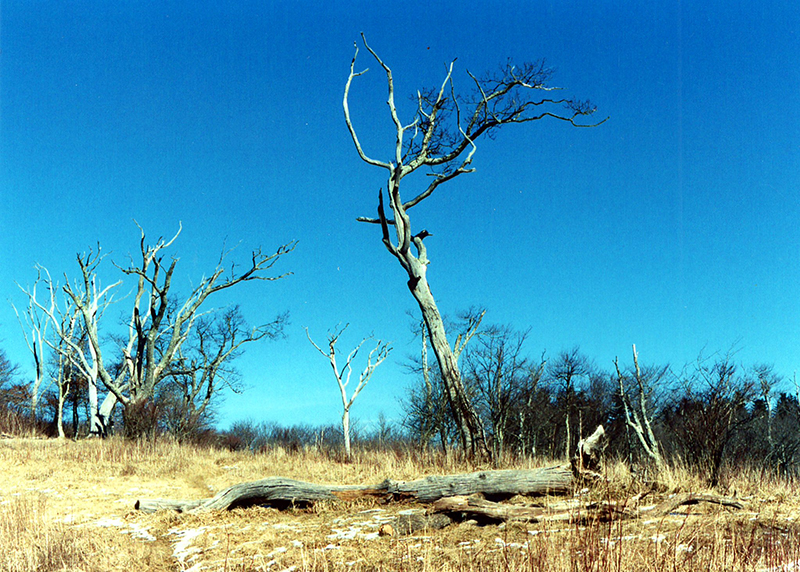
On Oct. 5, 1988, the Graham County Rescue Squad was advised of the search for Jim Michelic, a 25-year-old Wisconsin man who went missing after last being seen on the Wolf Laurel Trail on Sept. 27. Search and Rescue Coordinator for the Graham County Rescue Squad – Jack Jackson – headed up search efforts on their end.
On Thursday, Oct. 6, a large scale search was underway, with four search crews from Tennessee, search personnel from federal, state and local agencies, dozens of individual searchers, and dog teams joins local search personnel. The support from the local community was overwhelming with enough food and more supplied to feed the army of searchers.
The search continued until Oct. 9 and is scaled down after no trace of Michelic is found. In the following days, a few reports trickled in, with no results.
On Sunday, Oct. 16, 1988 two local fishermen – Willie Perkins and Charlie Mauck – decided to take a shortcut to Little Santeetlah Creek, which flows through the Joyce Kilmer Forest. They soon regretted their decision, as they enter dense rhododendron thickets and rock cliffs. They were in the same area that I was on the first day of the search, except farther downhill.
At the base of a rock cliff, they found a pair of boots and a backpack. These items were taken to the Graham County Sheriff’s Office, where relatives identified them as belonging to Michelic.
On Monday, Oct. 17 – the first day of big-game hunting season – a search crew consisting of personnel from the U.S. Forest Service, the N.C. Forest Service, the Graham County Rescue Squad, Graham County EMS, Graham County Sheriff Melvin Howell, J.D. Holder of Townson-Smith Funeral Home and other individuals – including Perkins and Mauck – started into the woods. After reaching the area where the boots and backpack were discovered, searchers spread out in the rugged area and soon located Michelic’s remains. There is evidence that a bear had been feeding on the corpse. Further evidence at the scene indicated that Michelic had fallen off the rock cliff, striking his head on a rock.
On Oct. 19, Dr. Thomson – who had performed the autopsy on Michelic – called me with the following information: the cause of death was injuries received from the fall, including a fracture at the base of the skull and a brain hemorrhage. There was a spinal fracture near the base of the spine. Michelic had been dead close to three weeks, probably since the day he first came to the area.
The fall would have caused unconsciousness. Michelic would have been unable to walk and would have lived only a short time. The head injury was the fatal wound. The bear activity with the body was after death, probably when the body started decaying.
Searchers still believe Michelic had started back to his car from the tent on Stratton Bald and was caught by darkness. He probably lost the trail in a switchback, and wandered into the rugged area and eventually, his untimely death.
Part 1 of this column appeared in the Oct. 8 edition of The Graham Star.
Marshall McClung is the historical columnist for The Graham Star.