

Marshall McClung
Upon arriving at the site of a plane crash in the mountains, rescuers are not expecting to find anyone alive – and are usually met with a graphic scene.
On one occasion though, they were met with a total surprise.
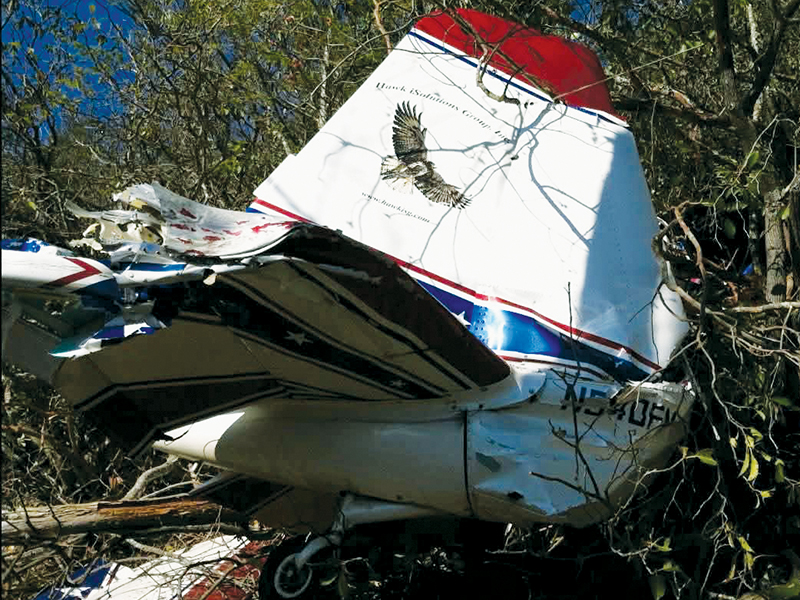
Tory Lynnes and Steve Kali recently visited a crash site a little over two miles outside Graham County in the edge of Tennessee. The crash occurred on Sunday, March 23, 2014.
Jim Maroney had left the French Lick, Ind., Airport in his 1947 DeHavilland DHC-1 aircraft, and was en route to Canton, Ga., to attend an air show. He had contacted a flight service station that morning for a weather briefing. He was told that VFR (flying by sight) was not recommended. He was also informed that the higher mountain tops would be obscured by low clouds.
Maroney was an experienced pilot, but his aircraft was not equipped for those conditions.
When Maroney did not arrive at his destination, a search mission was launched. The next day, broken treetops and pieces of the aircraft were spotted in the Cherokee National Forest near Stiff Knee Knob – at an elevation of 2,222 feet. Had the plane been about 200 feet higher, it would have cleared the mountain. A local resident said that all the mountaintops were covered in low clouds at the time of the crash.
When rescuers reached the crash site, they were not surprised to find that Maroney had been killed. The surprise was that he was wearing a parachute.
In the many plane crashes I have been to, no one was wearing a parachute. Speculation was that he had worn one since his plane was so old that if the engine quit mid-flight, he would bail out.
It is believed that Maroney encountered the clouds and was turning around when his plane hit the mountainside.
Marshall McClung is the historical columnist for The Graham Star. He is retired from the U.S. Forest Service and can be reached via email, mcclungs828@gmail.com.