

Eric Reece
There was a time in the Christianity where a separate building was used for baptisms.
In the period between the Seven Councils and the Middle Ages, a round or five-sided building was built next door to the cathedral as the place to administer the sacrament of baptism.
The architecture was beautiful and the artwork inside was breathtaking; many fine examples are found in Europe.
Around the advent of the Renaissance – as Christianity continued to grow – separate baptistries ceased to be built and a location for baptismal fonts in the sanctuary of the church took their place. These fonts were made of wood, marble or metal and were works of art. Fast forward to the American frontier and baptisms were in the river or a baptism bowl was used in church.
As the log and white plank churches were modernized or replaced, indoor baptistries were included in many sanctuaries. Some were free-standing, but many were added in the chancel area with steps leading down into the pool. No matter the season, when a revival was held or a person was saved an indoor baptism could follow as soon as the pool was filled.
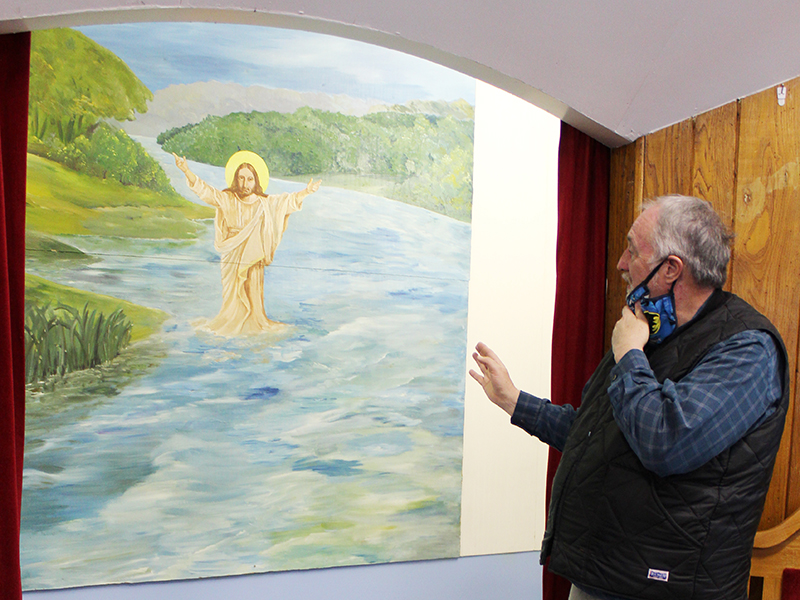
Soon, a form of artwork emerged in American churches. Baptistry paintings – large and hand-painted, and often created by local artists – became the artwork in many churches.
They became popular around the turn of the 20th century and were included in many post-war church buildings.
Each one an original for the church, these scenes showed a mountain in the background, a clear blue sky, green grass, reeds or trees and the Jordan River seemingly emptying into the baptism pool. The baptistry painting became a way to take the new believer and the church family back to the site of Jesus’ baptism.
Graham County is blessed with a number of baptistry paintings and some were painted by the late Mary Howell, a local school art teacher. Her daughter Elaine confirmed that her first baptistry painting was at Sweetwater Baptist. It took many hours and she worked long days during the summer to finish it before the new school year. This beautiful Jordan River scene has Jesus with a nimbus (halo) looking out at the congregation.
If you have not had an opportunity to see this painting, please do.
In addition, she painted the baptism scene at Tuskeegee Baptist and an outdoor baptistry painting at Bear Creek Baptist. The Tuskeegee painting has a white dove hovering over the water, reminding us of the ever present Holy Spirit. The Bear Creek painting has Jesus looking out watching over the community.
There is a concern that baptistry painting is becoming a lost art.
Even worse, with the changing religious landscape, paintings will be lost.
Many were painted directly on the wall and cannot be removed.
If your Graham County church has a baptistry, baptism or other type painting in your sanctuary, please send the church name, artist and date painted (if known) and I will work to record our sacred folk artwork.
We may not be able to stand on the banks of the Jordan right now, but this sacred artwork will take us there.
Eric Reece is the faith columnist for The Graham Star. He is pastor of Robbinsville United Methodist Church and can be reached via email, ereece@wnccumc.net.