
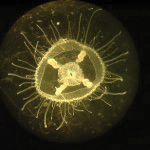
The medusa form of the Craspedacusta sowerbii is the size of a penny. Photo by Lisa Gershwin
The existence of the Eastern Mountain Lion might be an item of hot debate in western North Carolina, but scientists have confirmed the existence of an even more unlikely critter: freshwater jellyfish.
According to Gary Peeples of the U.S. Fish & Wildlife Service in Asheville, Lake Santeetlah and Fontana Lake are just two of at least eight bodies of water in North Carolina found to harbor the tiny creatures.
Only reaching the size of a penny, the animals pose no direct threat to humans, though their effect on the ecosystem has yet to be determined. The freshwater jelly uses stinging cells to feed, but their microscopic size limits their ability to puncture human skin.
In spite of its common name, Craspedacusta sowerbii is not a true jellyfish, but a hydrozoa closely related to the Portuguese man o’ war. Craspedacusta morphs through five incarnations during its life-cycle, and during the hydromedusa stage, the creature resembles a miniature jellyfish. Known as the “peach blossom fish” in its native China, the freshwater jellyfish is now found in the waters of every continent but Antartica.
Freshwater jellyfish expert Dr. Terry Peard believes the animals are not picky about where they live.
“We have observed them in waters ranging from crystal clear rock quarries to soupy green farm ponds,” said Peard.
The animal’s migration from China to the rest of the globe followed the stocking of fish, such as tilapia, as well as the movement of aquatic plants and the migration of birds.
The first sighting outside of China occurred in 1880 in the water lily tanks at London’s Regent Park, probably after the jellies travelled along with imported plants and fish. While in either its polyp or podocyst life-stage, the creature may easily hitchhike undetected by human, fish, or bird.
Like true jellyfish, the freshwater jellies feed on plankton, but scientist do not yet know whether their presence may reduce plankton to unhealthy levels.
Plankton is crucially important to the ecosystem, as it forms the bottom of the food chain, meaning that any negative effect on the plankton population could have far-reaching effects. The jellies might also change oxygen levels in bodies of water, but, again, the effect has not yet been proven.
Although jellyfish in local lakes may seem unlikely, the species is common on six continents, with scientists confirming populations in 44 states, including North Carolina.
Sightings of freshwater jellies may be reported to tpeard1700@comcast.net. More information may be found at freshwater
jellyfish.org.